
Irrigation is a topic we’ve covered in several articles, and today we begin “Types of Surface Irrigation (III)” with flood irrigation and free-flow or closed-field irrigation.
In upcoming articles, we’ll discuss furrow irrigation and pressurized or mechanized irrigation methods such as sprinkler and drip irrigation. We already emphasized in the first article the importance of choosing the right irrigation method.
Surface irrigation
This type of irrigation is characterized by applying water to the soil surface. The water flows by gravity and seeps into the ground.
While the water needs to be channeled to the crop and distributed across the land, it’s very economical because it doesn’t require extensive infrastructure.
Its suitability depends on the type of crop and the terrain’s topography.
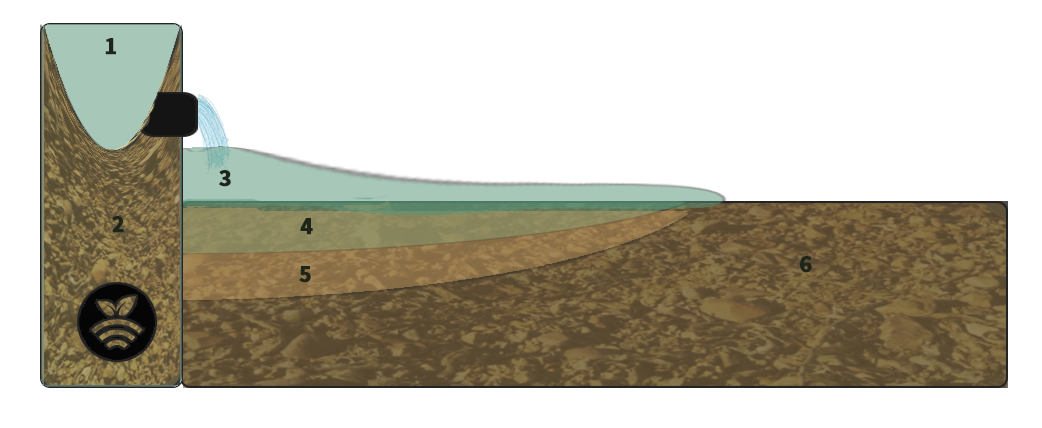
Irrigation by flooding or spreading
Flood irrigation is the oldest method of applying water to crops. Little preparation is done to level or even the soil, resulting in significant water loss. Generally, only 20 to 30 liters of water are actually used for every 100 liters applied.
The work and investment required for this method are limited to laying out the irrigation channels.
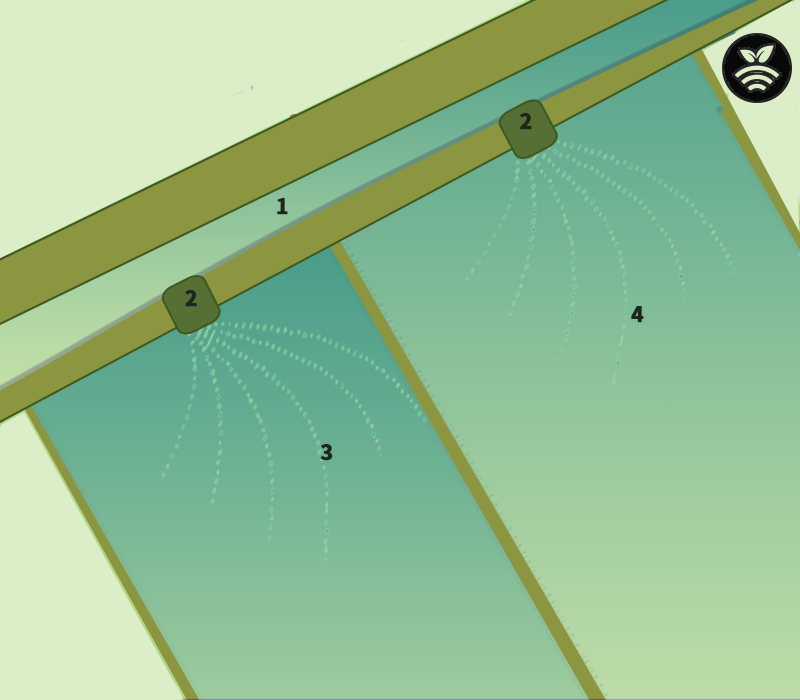
Flood or surface irrigation. 1-Water channel. 2-Water outlet gates. 3-Full irrigation bed. 4-Partially filled irrigation bed.
The distribution of channels in flood irrigation depends primarily on:
- The slope of the land.
- Distribution of channels to cover the highest point of the land.
- One or more water inlets can be used.
- It is especially advisable for pastures and cereal fields.
- The field should be divided into irrigation beds that allow for sectional irrigation.
- It is advisable that the land be flat.
Almost all soils and crops can be irrigated, but avoid irrigating row crops or fruit trees.
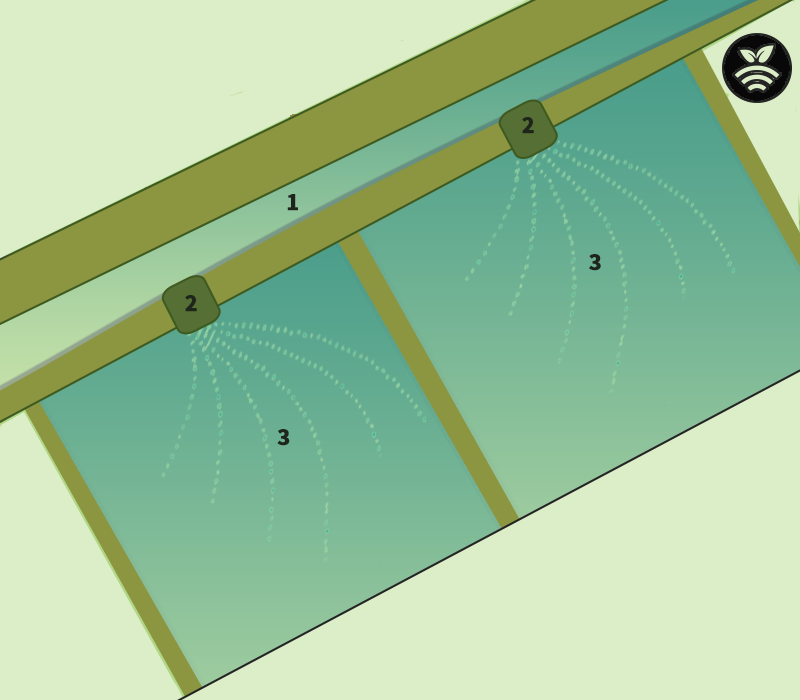
Flood Irrigation in Enclosed Beds. 1-Channel. 2-Sluice Gate. 3-Full and Partially Filled Beds
Basic Guidelines for Flood Irrigation
Due to the problems analyzed, this method is not recommended. However, efficiency can be improved by considering some management aspects such as:
- To raise the water level in the channel, use an irrigation mat or construct sluice gates.
- To remove water from the channel, use siphons, distribution boxes, or raised beds. Do not break the edges or banks of the channels.
- Make furrows with a gentle slope, a maximum of 8 cm in 10 meters, following the contour lines of the land (contour furrows), allowing the water to flow smoothly between furrows.
- Irrigate for the time necessary to wet the root zone of the crop.
- Use a quantity of water that you can easily control.
- Do not wait until the plants appear wilted to irrigate again.
- Water small sections of the plant so you can better control the water.
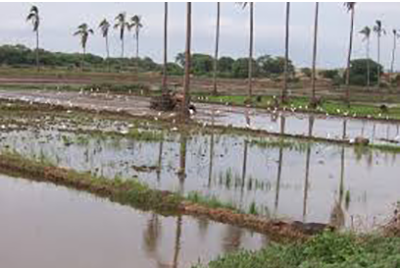
Flood Irrigation
Run-through Irrigation
This is similar to flood or surface irrigation, but for slightly sloping land, so that excess water is released at the end of the irrigated area.
It is therefore beneficial to collect excess water with collectors and store it for future irrigation.
If excess water cannot be collected, we must irrigate just enough so that the water reaches the end of the plot.
Run-through Irrigation in Enclosed Plots
In this case, the end of the plot is enclosed, so irrigation must be very carefully controlled because, since there is no runoff at the end of the plot, there is a risk of waterlogging at the edge of the field.
Source of the article:
